
August 12, 2026 · AI drug discovery, pancreatic cancer, and translational validation
AI Found a Way into an “Undruggable” Cancer Target—but Biology Had the Final Say
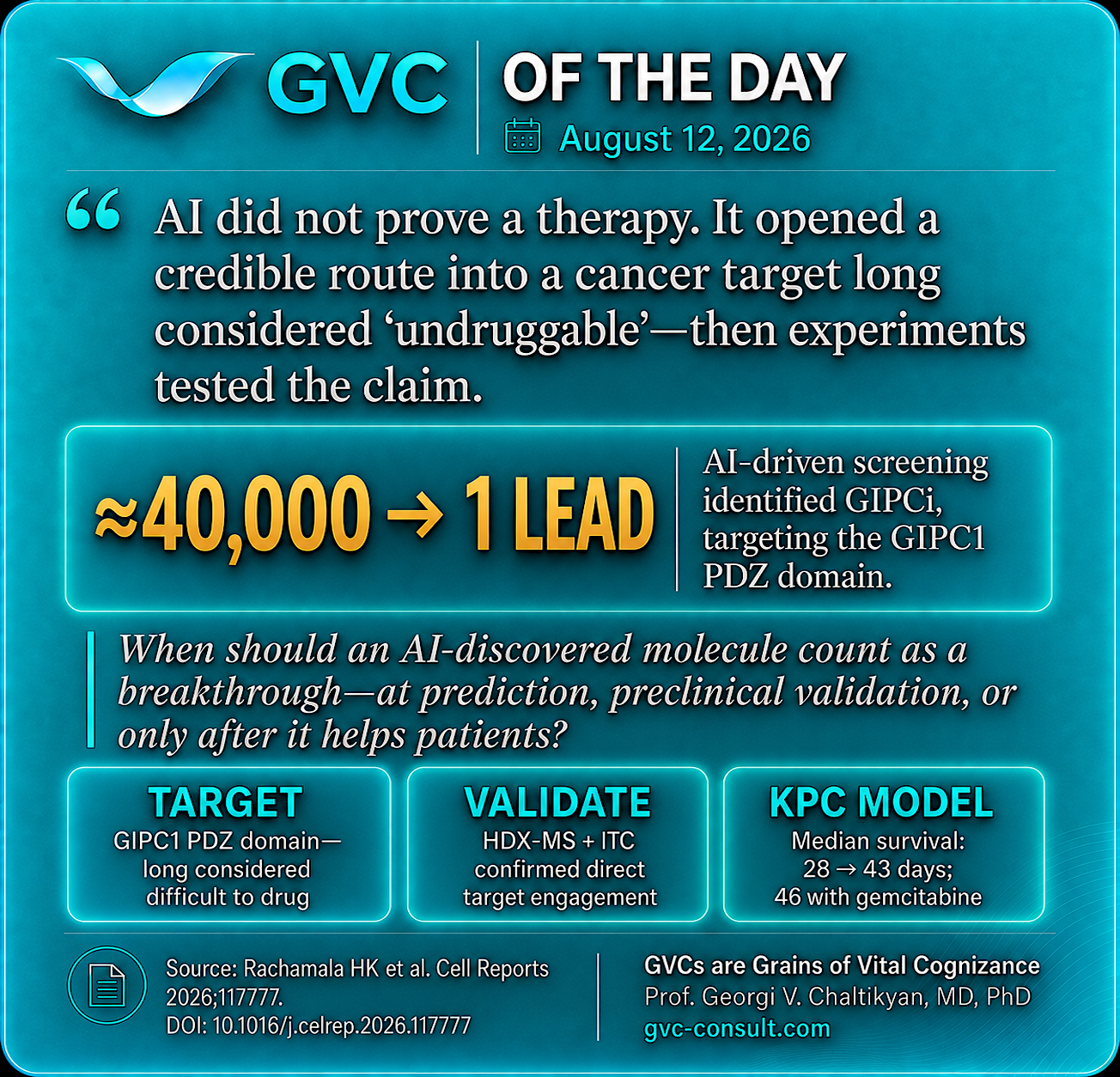
A new Cell Reports study reports the AI-driven discovery of GIPCi—a first-in-class small-molecule inhibitor targeting the PDZ domain of GIPC1, a protein associated with pancreatic-cancer growth and treatment resistance.
Researchers screened nearly 40,000 potential compounds before identifying GIPCi. They confirmed direct target engagement using HDX-MS and ITC, demonstrated tumour-growth suppression across preclinical pancreatic ductal adenocarcinoma models, and observed enhanced antitumour activity when GIPCi was combined with gemcitabine.
In mouse models, median survival increased from 28 to 43 days in the KPC model—and to 46 days with GIPCi plus gemcitabine. In the PANC-1 orthotopic model, it increased from 32 to 48 days—and to 54 days with the combination. No detectable systemic toxicity was reported in the evaluated models.
This is more than a molecular-docking result. AI narrowed the chemical search space, but the candidate still had to survive biochemical validation, cell-based experiments, mechanistic investigation, and multiple animal models.
My takeaway: the value of AI drug discovery should not be measured by how many molecules an algorithm can propose. It should be measured by how efficiently it helps produce experimentally validated candidates capable of advancing towards meaningful patient benefit.
GIPCi nevertheless remains an experimental, preclinical compound. Its pharmacology, selectivity, long-term toxicity, and clinical effectiveness in humans remain unknown. An “undruggable” target may have become experimentally accessible—but it has not yet become a proven therapy.
GVCs are Grains of Vital Cognizance, by Prof. Georgi V. Chaltikyan, MD, PhD.