
August 18, 2026 · Social determinants, epigenetic ageing and longevity policy
Social Experience May Enter the Body Through the Biological Clock
Longevity is increasingly presented as something individuals can optimise through tracking, nutrition, supplements and testing. But biology may also carry our social history.
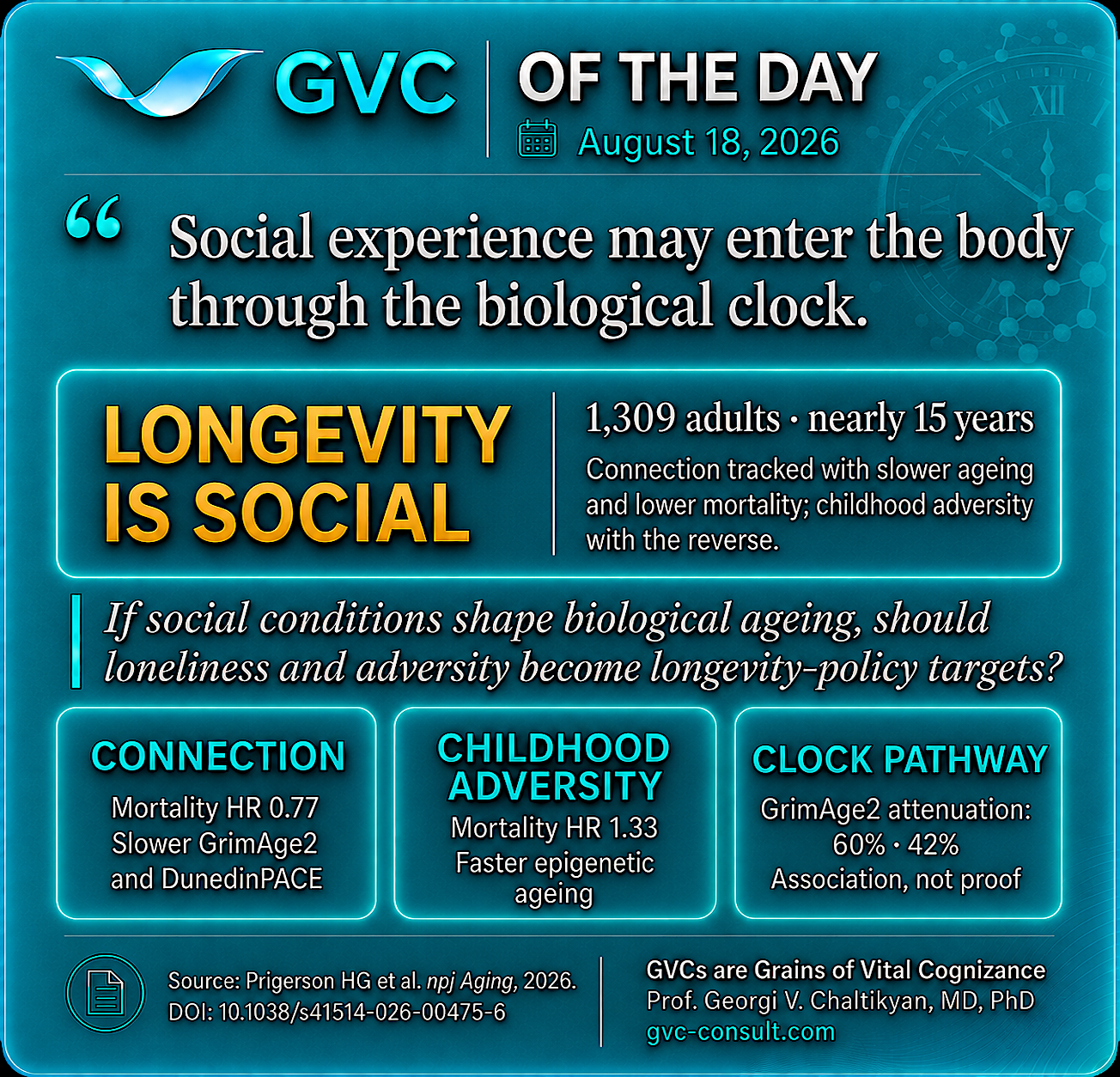
A new npj Aging study examined 1,309 adults from the MIDUS cohort over an average follow-up of 14.7 years. During that period, 150 participants died.
Positive social experiences were associated with slower epigenetic ageing, better health and a lower mortality hazard (HR 0.770). Negative childhood experiences were associated with faster biological ageing, poorer health and a higher mortality hazard (HR 1.325). Negative experiences in adulthood were not associated with mortality after adjustment.
When GrimAge2 was added to the mortality models, the association with positive social experiences weakened by 59.8%, while the association with childhood adversity weakened by 42.0%. This is consistent with epigenetic ageing being one possible pathway connecting social experience and survival.
However, the result depended on the biological clock used. DunedinPACE produced less attenuation, while PhenoAge produced little. The proposed pathway is therefore suggestive—not definitive.
My takeaway: longevity cannot remain an exclusively individual optimisation project. If social conditions become biologically embedded, childhood security, social connection and community infrastructure deserve consideration as components of serious prevention and longevity policy.
This was an observational study using self-reported experiences and a volunteer biomarker subsample that was not representative of the US population. Statistical mediation does not establish causality or prove that improving social conditions will slow ageing or extend life.
GVCs are Grains of Vital Cognizance, by Prof. Georgi V. Chaltikyan, MD, PhD.