
August 19, 2026 · Multimodal clinical AI, telehealth and the future of medicine
AI Is Learning to See the Patient. What Remains Uniquely Human?
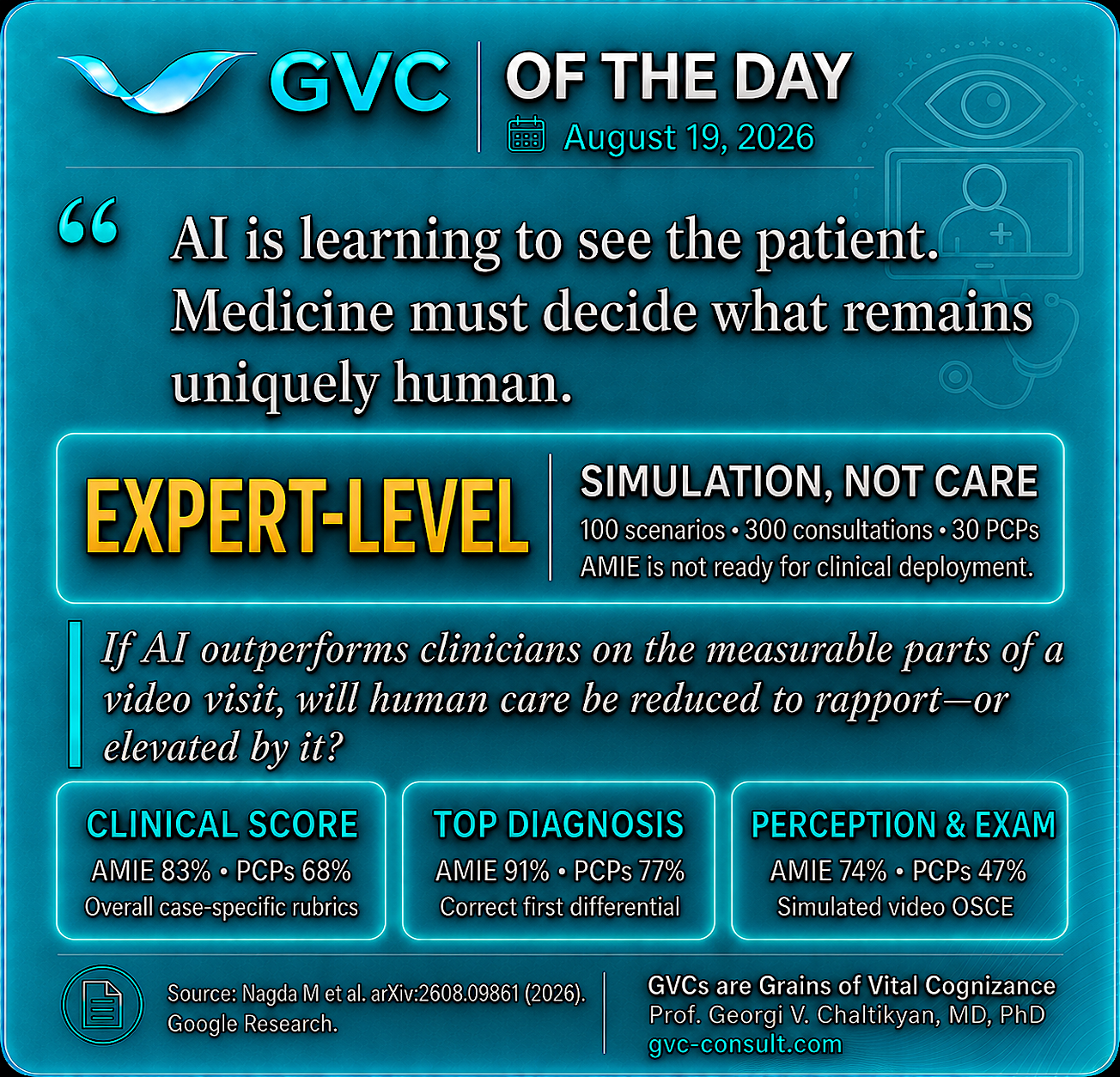
Google’s AMIE has moved beyond text chat. Its video configuration integrates real-time dialogue, clinical reasoning, and audio-visual perception through three cooperating agents: a patient-facing Talker, a clinical Planner, and a Perception agent.
A randomized simulated Objective Structured Clinical Examination compared AMIE Video, AMIE Text, and primary-care physicians across 100 clinical scenarios and 300 consultations. Ten physicians conducted the comparison consultations, 15 professional patient actors enacted the cases, and 20 independent physicians evaluated the results.
On the case-specific clinical rubrics, AMIE Video scored 83%, compared with 68% for physicians. It placed the reference diagnosis first in 91% of scenarios, versus 77% for physicians, and scored 74% versus 47% on perception and examination.
Patient actors preferred AMIE for assessing and explaining their conditions. They retained a non-significant preference for physicians on rapport and partnership. This distinction matters: the study measured simulated consultation performance—not the full meaning, responsibility, or continuity of clinical care.
My takeaway: the measurable parts of clinical work may become machine-capable faster than medicine can redefine human professional value. Saying that humans will provide “empathy” is no longer a sufficient answer. The clinician’s future role must encompass judgement under uncertainty, trust, values-sensitive decisions, accountability, physical care, and navigation through complex health systems.
This is a preprint based on simulated encounters with professional patient actors, not evidence of real-world clinical effectiveness or patient benefit. Physicians kept their cameras off, reducing the ecological validity of the human comparison. The system also missed some visual cues, struggled with subtle affect and rapid movements, and is explicitly described by its developers as not ready for clinical deployment.
Nagda M, Lee J, Thompson M, et al. Towards Expert-level Medical AI for Real-time Video Consultations. arXiv:2608.09861. Submitted August 10, 2026.
GVCs are Grains of Vital Cognizance, by Prof. Georgi V. Chaltikyan, MD, PhD.