
August 20, 2026 · Autonomous clinical AI, physician roles and competency-based regulation
Three Signals in 48 Hours: Is Medicine Entering the Age of the AI Clinical Actor?
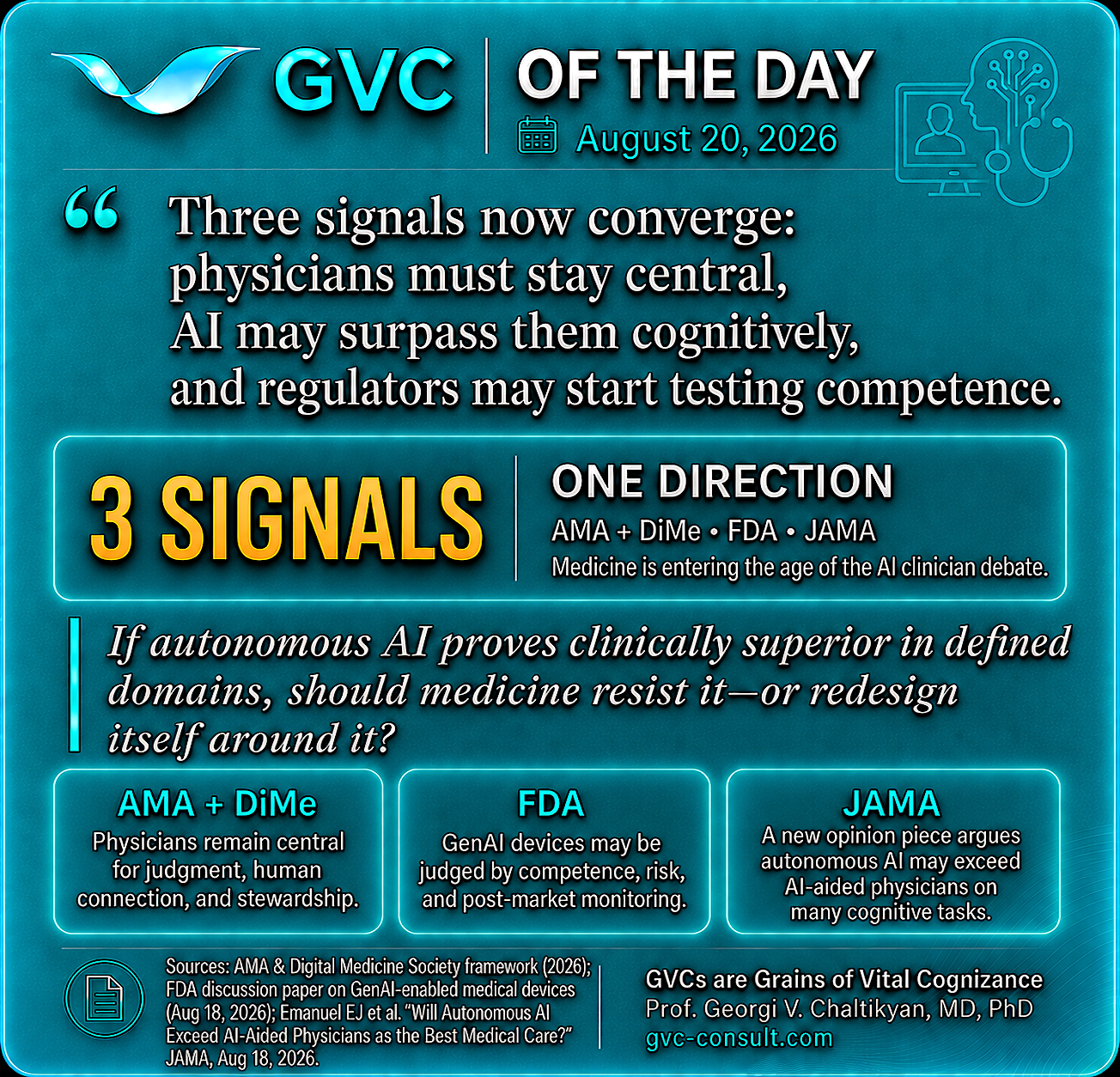
Three developments from the AMA and Digital Medicine Society, JAMA, and the FDA are converging on a much larger question: if AI increasingly performs clinical cognitive work at—or beyond—physician level, should it remain merely a tool, or eventually become a regulated clinical actor?
The AMA and Digital Medicine Society (DiMe) have published a new framework defining the physician’s role in the Digital and AI era. Their position is that technologies and individual tasks will change, but physicians retain enduring responsibilities around clinical judgement, human connection, and responsible stewardship of technology.
At almost the same time, Ezekiel Emanuel, Abe Baker-Butler, Neal Khosla and Vinod Khosla published a provocative JAMA Perspective asking whether autonomous AI may eventually outperform not only physicians, but AI-aided physicians. They argue that current evidence already shows strong performance across several cognitive medical tasks and foresee autonomous AI becoming deployable in at least some workflows by around 2030.
Then came perhaps the most consequential signal: the FDA is explicitly considering a competency-based approach for evaluating GenAI-enabled medical devices. Its discussion paper proposes assessment of clinical knowledge, analytical capability, safety behaviour, communication, generalizability and clinical confirmation, proportionate to intended use and risk.
Remarkably, the FDA paper directly cites the April JAMA proposal by Alon Bergman, Robert Wachter and Ezekiel Emanuel for a licensure-like framework for autonomous clinical AI—with defined scope of practice, time-limited certification, ongoing monitoring and explicit accountability. The FDA says its own proposed approach is inspired, at a high level, by how human clinicians are evaluated and credentialed.
This is not AI licensure yet. The FDA document is a discussion paper, does not represent draft or final guidance, and remains within medical-device regulation. The JAMA article is a Perspective, not a clinical trial demonstrating that autonomous AI improves patient outcomes. But the conceptual direction is striking:
Product performance → clinical competence
One-time approval → continuing evaluation
“What software is this?” → “What is this AI qualified to do?”
My takeaway: the old question “Will AI replace doctors?” is becoming less useful. The more consequential questions concern scope of practice, demonstrated competence, autonomy, accountability—and which clinical functions genuinely require a human physician.
Emanuel EJ, Baker-Butler A, Khosla N, Khosla V. Will Autonomous AI Exceed AI-Aided Physicians as the Best Medical Care? JAMA. Published online August 17, 2026.
U.S. FDA. Considerations for the Regulation of Generative AI-Enabled Medical Devices: Discussion Paper and Request for Feedback. August 2026.
Bergman A, Wachter RM, Emanuel EJ. A Licensure Framework for Autonomous Clinical AI. JAMA. 2026;335(20):1751–1754.
GVCs are Grains of Vital Cognizance, by Prof. Georgi V. Chaltikyan, MD, PhD.