
August 31, 2026 · Digital biology, virtual cells and AI-driven experimentation
Can AI Become a Virtual Laboratory for Biology?
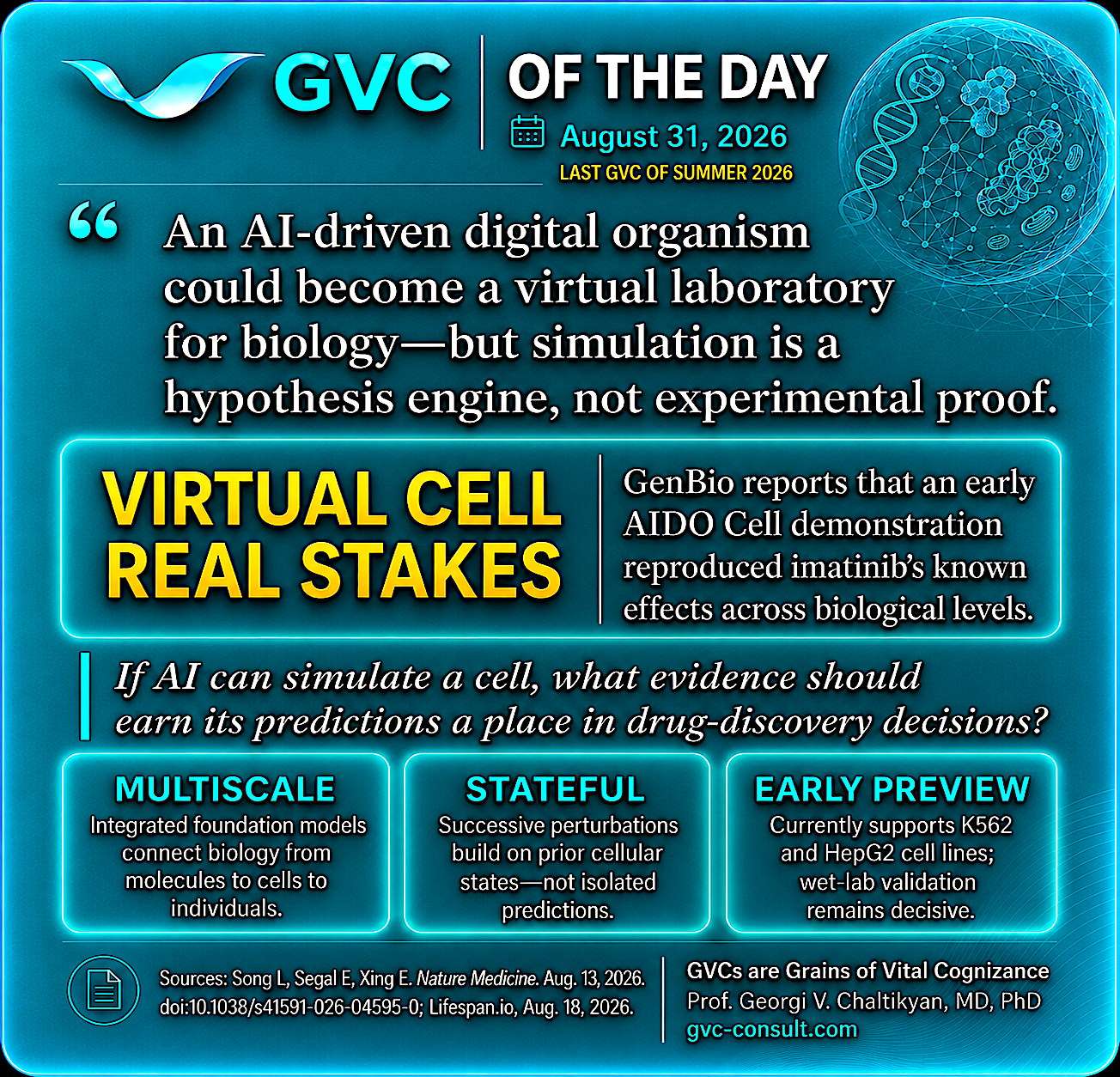
A new Nature Medicine Perspective proposes an AI-driven digital organism, or AIDO: a modular system of interconnected foundation models representing biology across multiple scales—from DNA and RNA to proteins, pathways, cells, tissues and individuals.
The ambition is not another model that predicts one biological property. It is a multiscale, stateful simulator in which successive perturbations build on previous cellular states rather than being treated as isolated predictions.
GenBio AI says an early implementation is already taking shape. Its AIDO Cell 1.0 currently provides prototype virtual cells for K-562 leukaemia and Hep-G2 liver-derived cell lines. The company reports using the K-562 model to simulate imatinib’s cellular effects and generate structurally novel candidate molecules intended to reproduce aspects of its biological response.
Potential applications include drug and candidate screening, gene-perturbation experiments, mechanism exploration, detection of weak hypotheses and prioritisation of expensive laboratory work.
My takeaway: the real promise is not replacing experiments. It is deciding which experiments deserve to be done.
A sufficiently accurate virtual cell could function like a flight simulator for biology: perturb a gene, introduce a drug, predict multiscale consequences, generate hypotheses and test the strongest ones experimentally. This could eventually contribute to Digital Health Twins and the infrastructure supporting 10P-Health.
But simulation is a hypothesis engine—not experimental proof. AIDO Cell remains an early company-developed preview limited to two extensively studied cell lines. Its imatinib demonstrations are vendor-reported case studies, not independent prospective validation of novel drug candidates.
Biological data remain incomplete, correlation does not establish causation, and errors may propagate when models are connected across scales. Wet-lab experiments—and ultimately clinical evidence—remain decisive.
GVCs are Grains of Vital Cognizance, by Prof. Georgi V. Chaltikyan, MD, PhD.