
September 16, 2026 · Digital twins, precision health and longitudinal modelling
From Organ Model to Whole-Person Digital Twin
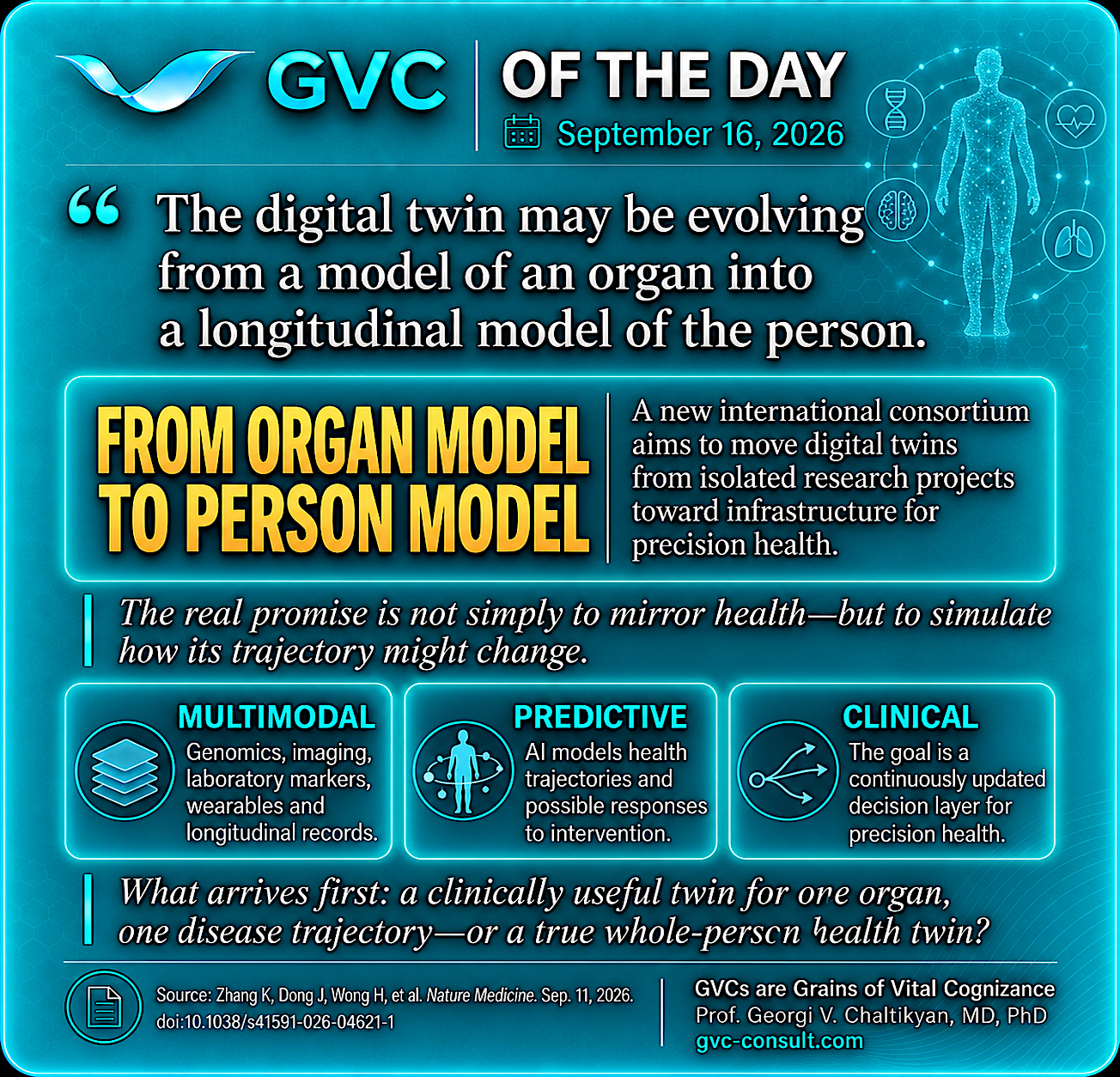
A new Nature Medicine Comment introduces the International Consortium of Digital Twins in Healthcare and Medicine. Its ambition is to move medical digital twins beyond isolated research projects and toward shared infrastructure for precision health.
The framing extends well beyond a digital heart, liver or tumour. The proposed direction is a global digital navigator of human health: a longitudinal model integrating genomics and molecular data, imaging, laboratory markers, wearable signals, health records and AI-based trajectory modelling.
From representation to simulation
The deeper promise is not simply to mirror a person’s current state. It is to estimate where their health trajectory is heading, simulate possible responses to intervention and compare what might happen if care begins now rather than years later.
That is the architecture we have long associated with 10P-Health and Digital Precision Health: integrated, longitudinal and increasingly actionable intelligence centred on the person.
My takeaway
The emerging progression is consequential: digital twin as a research model, then as a clinical decision layer, and eventually as longitudinal health infrastructure.
Important limitation: medicine remains far from a faithful digital copy of a human being. Multimodal integration, causal modelling, interoperability, privacy, governance and clinical validation remain formidable challenges. Twin-informed decisions must ultimately prove that they improve real outcomes.
GVCs are Grains of Vital Cognizance, by Prof. Georgi V. Chaltikyan, MD, PhD.