
September 28, 2026 · AI in science, wet-lab biology and research governance
Claude Gets a Pipette: AI Moves into the Wet Lab
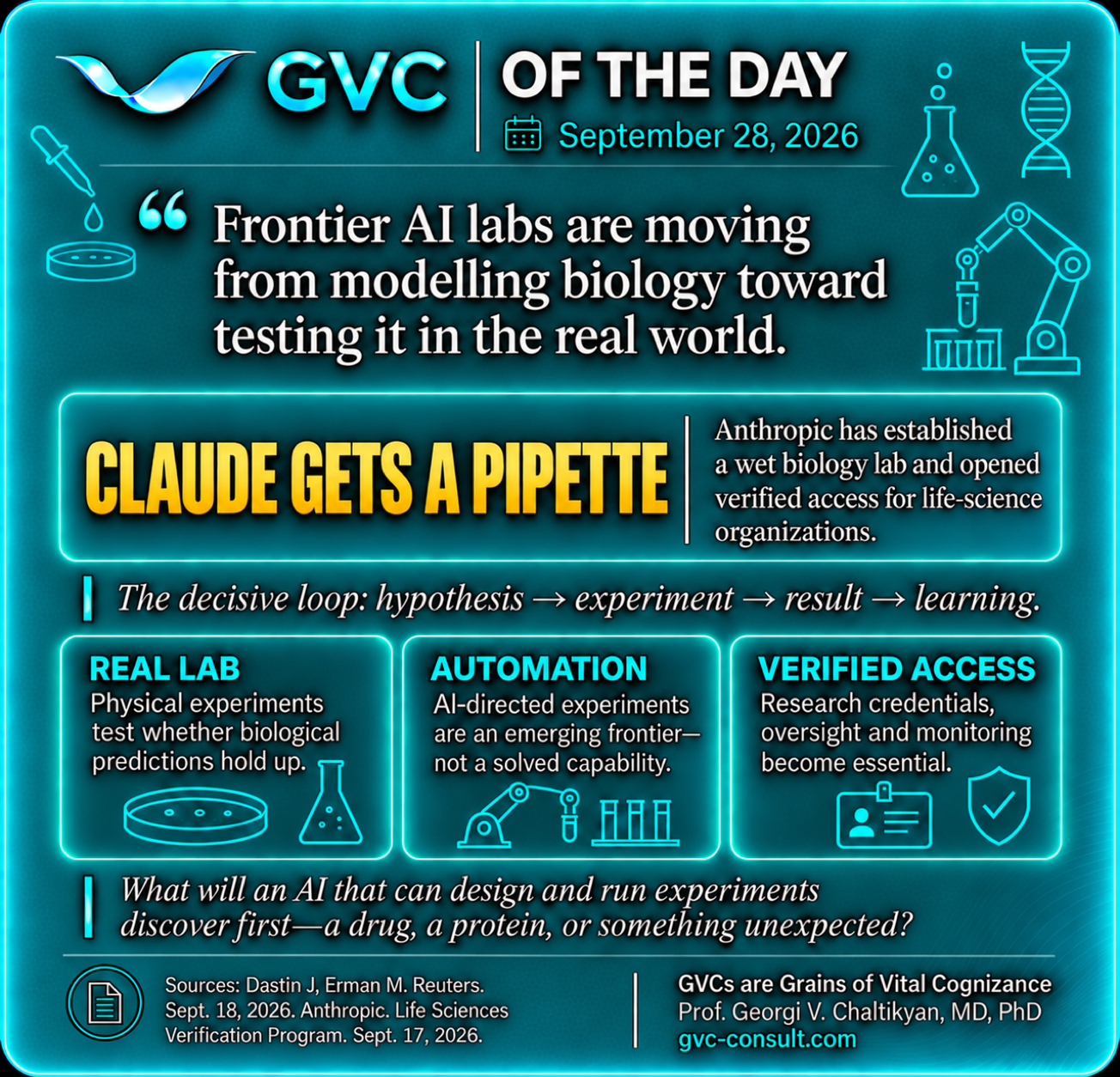
Anthropic has established a wet biology laboratory in the Bay Area, according to Reuters. It has also launched a Life Sciences Verification Program that offers qualified teams more permissive, monitored access to its models for legitimate work across research biology, drug discovery, clinical development and manufacturing.
The important shift is the possibility of closing a scientific loop: hypothesis → experiment → result → learning → next experiment. AI can help propose and prioritize ideas, while physical experiments reveal whether those ideas survive contact with living systems.
My takeaway
Biology remains difficult to predict from literature and benchmarks alone. Cells are messy, experiments fail, and context changes outcomes. Bringing frontier models closer to lab automation could accelerate iterative research—but the existence of a wet lab does not mean that autonomous, reliable AI-directed experimentation is already a solved capability.
That proximity also raises the stakes. Anthropic’s verified-access programme uses credential review, oversight requirements and monitoring. As AI takes a larger role in designing or directing experiments, validation, human accountability and biosecurity must remain part of the same loop.
GVCs are Grains of Vital Cognizance, by Prof. Georgi V. Chaltikyan, MD, PhD.